Last updated: August 21, 2026
In 2023, two New York lawyers were fined $5,000 for filing a brief full of cases that never existed — ChatGPT invented all six citations. The sanction was for the fabrication. The lesson nobody drew from it: every one of those fake-case prompts, plus the client’s injury facts, went through OpenAI’s servers first. In June 2026, the State Bar of California’s 2026 guidance made the risk official: a lawyer “must not input any confidential information of the client into a generative AI solution that may present material risks to confidentiality or security, absent informed client consent.”
That sentence describes every consumer chatbot on the market. And it applies to more professions than law.
This is the guide to running AI workflows that never leak — what the risks actually are (verified, not vibes), the zero-infrastructure option that takes ten minutes, and the full self-hosted stack for when the answer needs to never leave the building.
Who Actually Needs Private AI (It’s Not Just Lawyers)
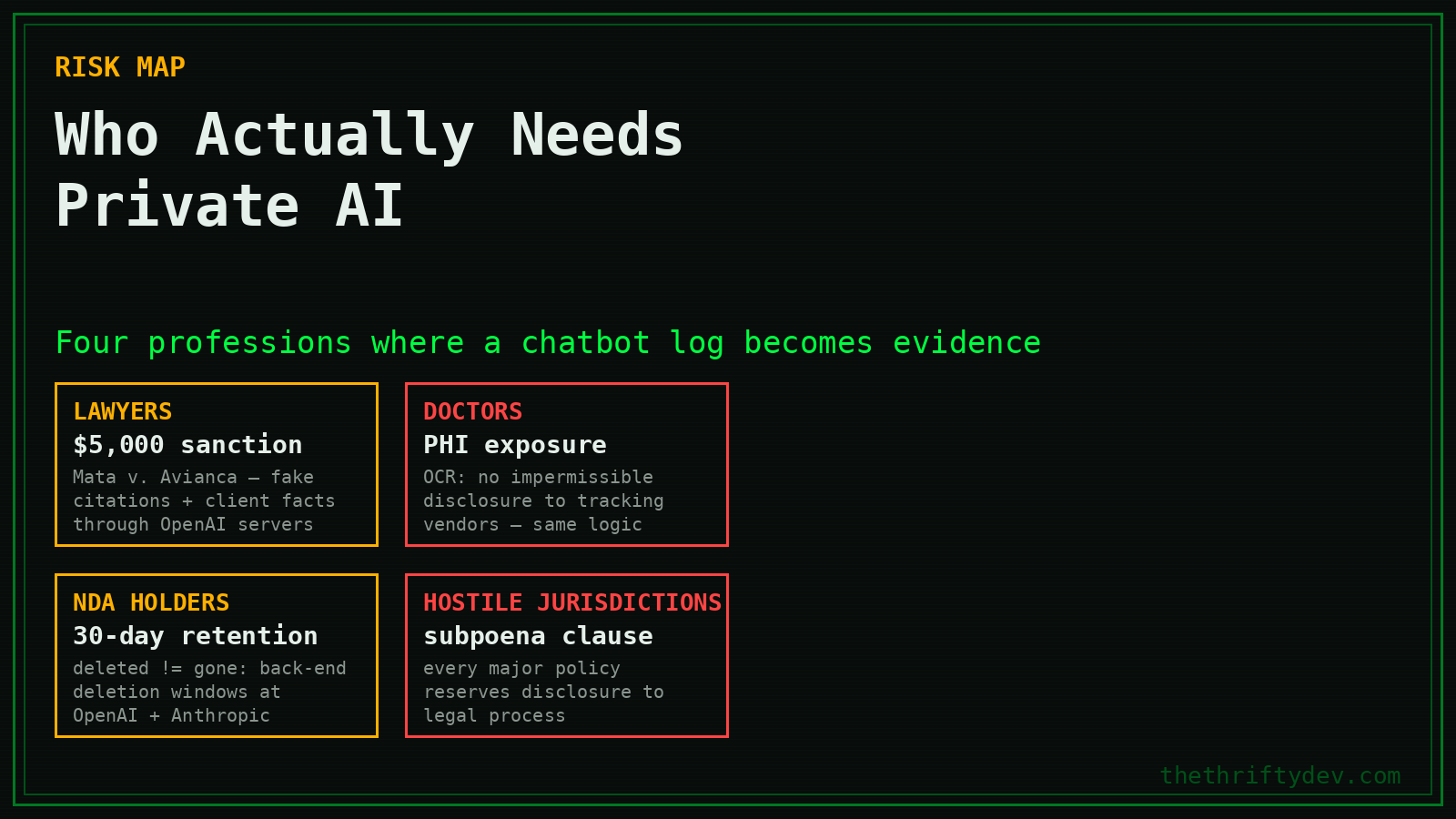
Lawyers. The Mata v. Avianca sanctions ($5,000, S.D.N.Y., June 22, 2023 — the court found “subjective bad faith”) made AI hallucinations a bar-discipline topic. But the bigger exposure is quieter: pasting a client’s settlement position into a chatbot that trains on inputs. California’s 2026 guidance says it plainly: “Generative AI products often utilize the information that is input by the user, including prompts and uploaded documents or resources, to further train or refine the AI, and might also share such information with third parties.” Client confidences, per rule 1.0.1(e), require informed consent before they touch that machinery.
Doctors and health workers. HHS’s Office for Civil Rights has stated that “regulated entities are not permitted to use tracking technologies in a manner that would result in impermissible disclosures of PHI to tracking technology vendors.” (A June 2024 federal court order, AHA v. Becerra, vacated a portion of that guidance — the fight continues — but the underlying Privacy Rule exposure is untouched.) Pasting patient facts into a consumer chatbot is the same category of disclosure with none of the paperwork.
Anyone under NDA. Source code, unreleased financials, merger terms, client lists. Anthropic’s own privacy policy reserves the right to share data “with government authorities, law enforcement, or other third parties where disclosure is reasonably necessary to comply with applicable law” — and deletion isn’t instant: deleted conversations are “automatically deleted from our back-end within 30 days.” OpenAI’s policy mirrors it: deleted chats are “scheduled for permanent deletion from OpenAI systems within 30 days, unless… OpenAI must retain it longer for security or legal obligations.”
People in hostile jurisdictions. Every mainstream AI policy contains a subpoena clause. Venice’s own legal page — a privacy-first service — still carries the standard language: data may be disclosed “to comply with law enforcement requests and legal process, such as a court order or subpoena.” If a privacy-first vendor has to say it, assume everyone can be compelled. But read the clause against what each vendor actually has to hand over: a subpoena can only reach stored data. A ChatGPT-class service holds your account identity, full chat history tied to it (until you delete — then up to 30 more days on the back end), and usage patterns. Venice, by its own policy, collects “basic metadata” for anonymous use — “time zone, browser type, and IP address” — and “does not collect or retain your Prompts or Outputs,” because conversation history never leaves your device. The legal exposure exists at both; the data surface area is different in kind. For a journalist in Ankara, the difference between “they can subpoena my chat logs” and “there are no chat logs to subpoena” is the whole ballgame.
The pattern across all four: the risk isn’t that AI is smart, it’s that your inputs become someone else’s records.
What Consumer AI Actually Does With Your Data
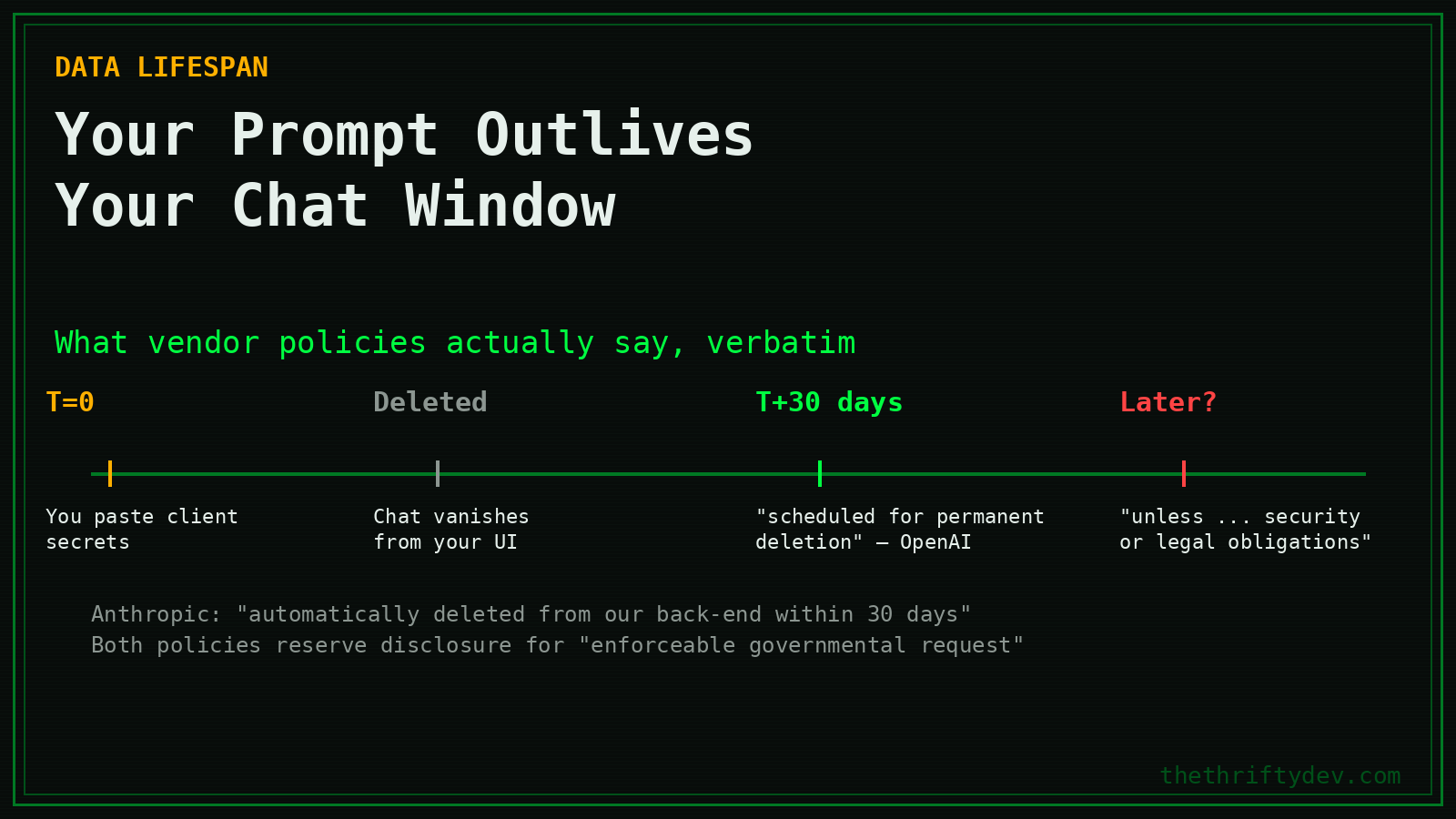
Three facts, each from the vendor’s own policy:
- Chats persist until you delete them — and deletion takes up to 30 days on the back-end (OpenAI, Anthropic — both verified above).
- Legal process reaches stored chats. Both companies reserve disclosure to comply with enforceable government requests.
- Default training exposure exists on consumer tiers unless you find and use the opt-out — and California’s bar guidance notes inputs may be used “to further train or refine the AI.”
None of this is scandalous. It’s just incompatible with privilege, PHI, NDAs, and hostile-state opsec. Which is why the fix matters.
The 10-Minute Fix: Venice.ai (Zero Infrastructure)
Try Venice.ai free — the fastest private-AI workflow you can stand up today.
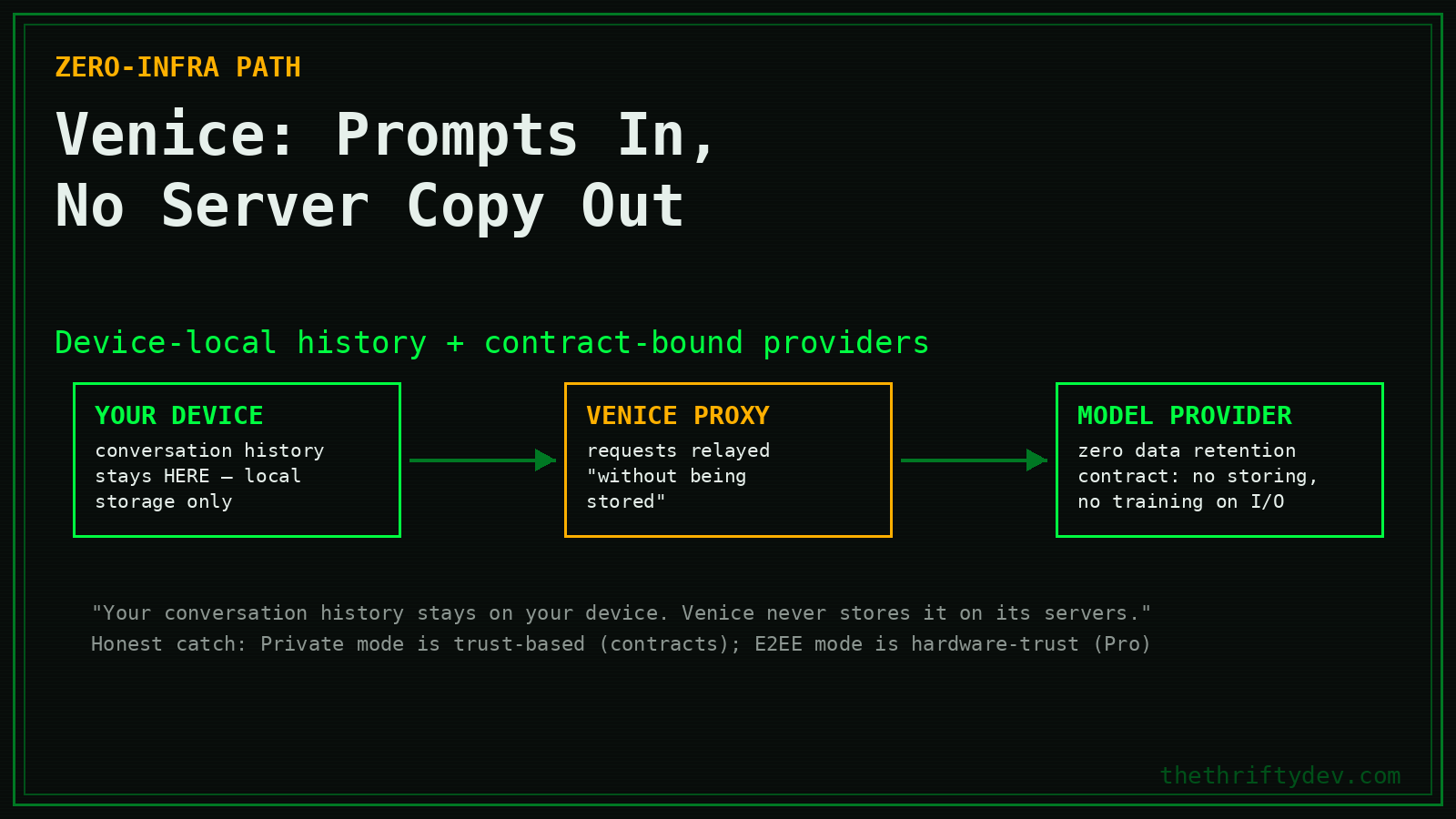
Venice’s architecture inverts the default: “Your conversation history stays on your device. Venice never stores it on its servers.” Prompts pass through a proxy to model providers. On Private mode (the default), inference runs on Venice-controlled GPUs or zero-retention partner infrastructure under what their policy calls “a zero data retention policy”: providers are “prohibited from storing, retaining, or using any of your Prompts or Outputs beyond the time strictly necessary to process and return a response.” That cover stops at Private mode. Anonymous-mode requests go to frontier providers (GPT, Claude, Gemini) with your identity obscured but your prompt content fully visible, processed under the provider’s own retention policy, which Venice explicitly says it does not control. The practical rule: treat Anonymous mode like any consumer chatbot and keep names, client facts, and anything identifying out of the prompt.
Four privacy modes, and the honest differences matter:
| Mode | What it means | Catch |
|---|---|---|
| Anonymous | Identity obscured from the provider | “Assume the provider is storing your content”; keep PII out of these prompts |
| Private (default) | Contract-enforced zero retention | Trust-based — relies on contracts being honored |
| TEE Pro | Hardware-enclave processing | Pro tier only |
| E2EE Pro | End-to-end encrypted | Pro only; no web search/memory, slower |
That table is Venice’s own language, including the catches. No-logs-by-architecture beats a promise, and a contract beats a default — but read the “catch” column with a straight face, because that’s the actual security posture. The subpoena math follows from it: a compelled disclosure at Venice can yield metadata (IP, browser, time zone — account email if you registered), but not your conversations, because they were never stored. The same order served on a mainstream chatbot returns years of chat history tied to your account. (Full transparency: that’s my referral link — through Venice’s Invite & Earn program you get a $10 credit bonus on signup, and I earn $10 in credits if you go Pro. Free tier is real without it — 10 text prompts and 15 image prompts a day — Pro is $18/mo.)
Who this is for: the lawyer drafting client positions, the consultant under NDA, the clinician sanity-checking a de-identified note, anyone who needs private-AI-workflow-grade confidentiality without owning a GPU. Ten minutes, no server, done.
The Full-Stack Answer: Self-Hosted and Sovereign
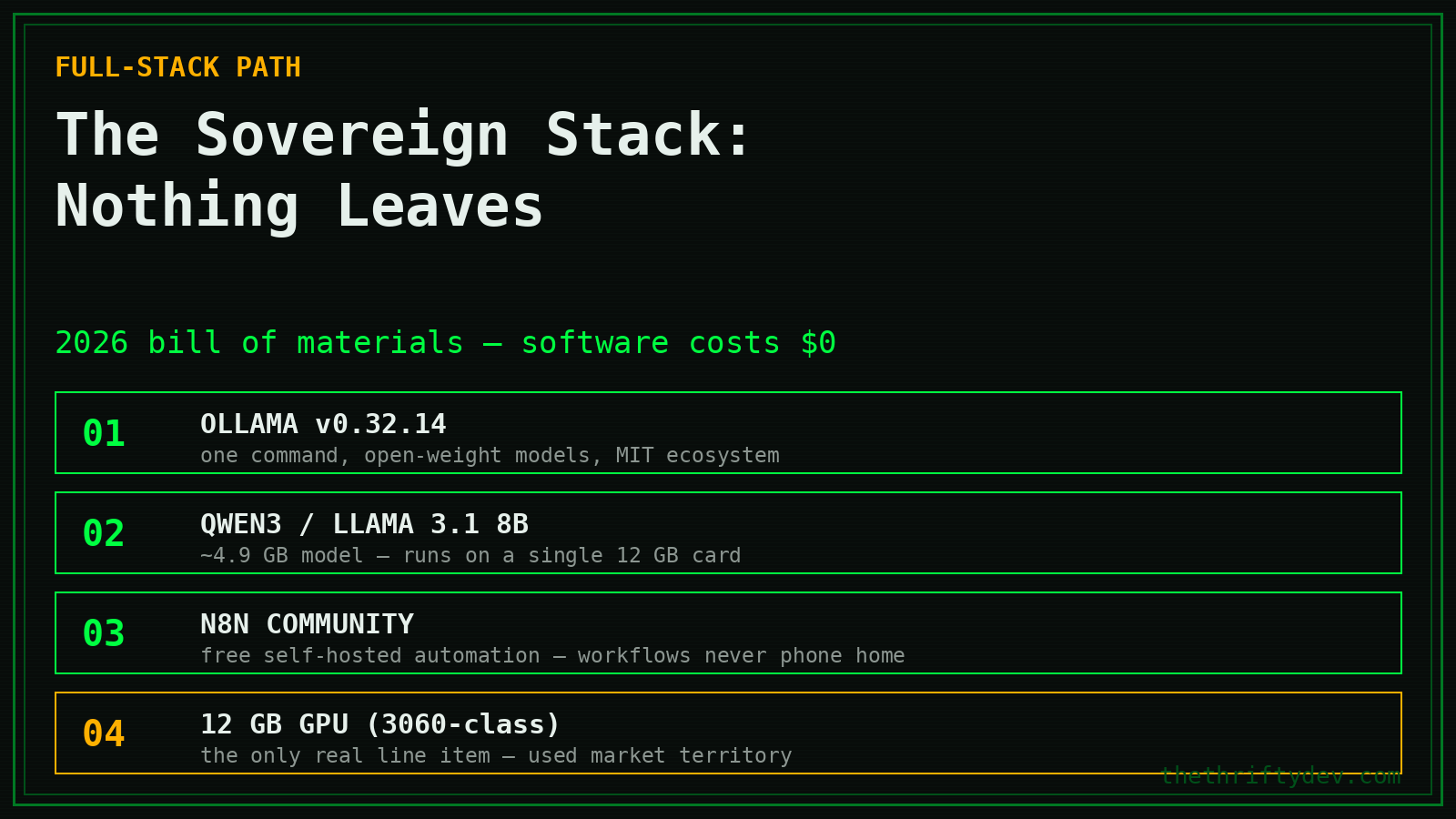
When even a proxy is too much exposure — regulated data, source code, anything that must never leave the building — you run the model yourself.
The 2026 bill of materials:
- Ollama (v0.32.14, free, open source) — one command runs open-weight models locally
- A capable model: Qwen3 ships at 0.6B through 235B; the 8B class (~4.9GB) runs on a single 12GB card. Llama 3.1 8B is the same footprint; the 70B class (~43GB) is multi-GPU territory
- n8n Community Edition (free, self-hosted) — “a standard, self-hosted version of n8n is available on GitHub”; wire it to your local model and you have automated workflows that never phone home
- Hardware: a used office PC plus a 12GB-class GPU (RTX 3060 territory) is the realistic entry point — the GPU is the budget item; software costs zero
Documents stay on the box. No retention window, no subpoena clause, no vendor. That’s not paranoia; it’s the same reason law firms still buy shredders.
Who this is for: the attorney whose IT policy forbids cloud processing, the developer automating over a proprietary codebase, the clinic that can’t sign another BAA.
Three Workflows You Can Build This Week
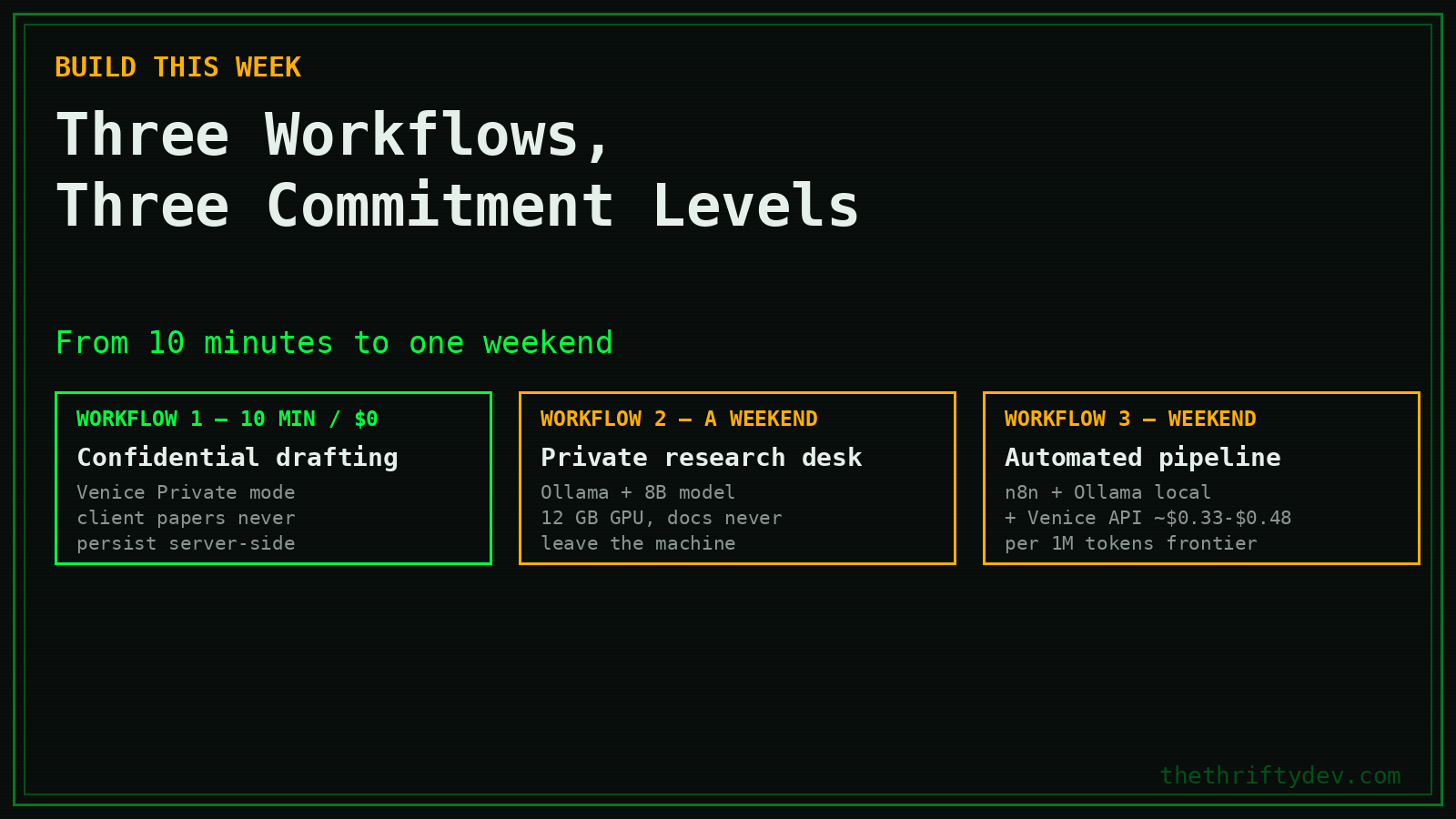
1. The confidential drafting assistant (10 minutes, $0). Venice Private mode as your drafting surface. Client position papers, sensitive emails, contract redlines. Nothing persists server-side. Cost: free tier or $18/mo.
2. The private research desk (one weekend, hardware cost). Ollama + an 8B model + a 12GB GPU. Point it at your documents; ask questions. The model has no internet, no telemetry, and no opinion about your retention policy. (Our local LLM beginner’s guide walks the whole setup.)
3. The automated private pipeline (one weekend, ~$0-18/mo). n8n self-hosted as the orchestrator, Ollama for local steps, Venice’s API for any stage that needs frontier quality — per-token pricing runs about $0.33/$0.48 per million tokens on the efficient models. Cron the routine work; keep the sensitive work local. (Our n8n self-hosted guide covers the plumbing.)
What Builders Should Do Now
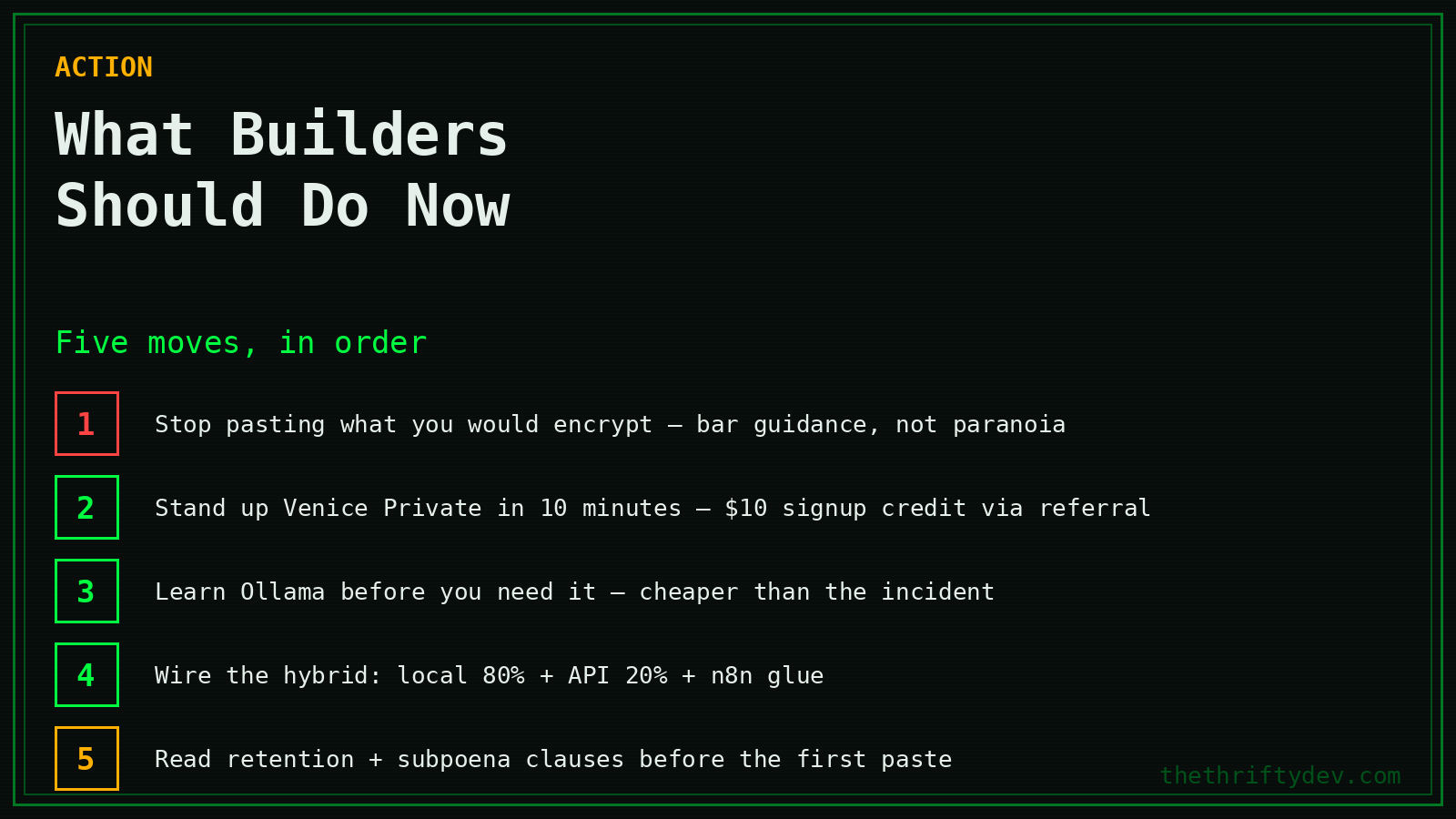
- Stop pasting anything you’d encrypt into a consumer chatbot. If privilege, PHI, NDA, or opsec applies, it doesn’t belong in a default-retention service — that’s now formal bar guidance, not paranoia.
- Set up Venice in ten minutes for the confidential drafting lane — free tier here, and the referral link gets you a $10 signup credit. Enable Private mode (it’s the default) and know which mode you’re in.
- Learn the self-hosted stack before you need it. The weekend you set up Ollama is cheaper than the incident that makes you wish you had.
- Wire the hybrid: local model for the sensitive 80%, API for the routine 20%, n8n gluing them. That’s the actual “private AI workflow” the search box promises.
- Read the privacy policy of any AI tool before the first paste — the retention and subpoena clauses are always there, and they’re always the story.
The lawyers in Mata learned the expensive way that a chatbot is a witness. Build like you know it.
Frequently Asked Questions
Can pasting into ChatGPT violate attorney-client privilege?
California’s 2026 bar guidance says lawyers must not input confidential client information into generative AI tools with material confidentiality risks, absent informed client consent. The same guidance notes such tools “often utilize” user inputs to train or refine the model. Source: State Bar of California.
Has a lawyer actually been sanctioned over AI use?
Yes. In Mata v. Avianca (S.D.N.Y., June 22, 2023), the court fined two lawyers $5,000 for submitting fake case citations ChatGPT had invented, finding “subjective bad faith.” Source.
Does Venice.ai store my conversations?
Venice itself stores nothing: “Your conversation history stays on your device. Venice never stores it on its servers.” On Private mode, model providers operate under zero data retention contracts. On Anonymous mode they do not; the frontier provider processes your prompt under its own policies, so keep identifying details out of Anonymous-mode prompts. Source: venice.ai/privacy.
Is Venice’s Private mode truly private?
It’s contract-enforced: providers are contractually prohibited from storing or training on your prompts and outputs. That’s trust-based rather than cryptographic — Venice’s own docs say so. The Pro tier adds TEE (hardware enclave) and E2EE (end-to-end encrypted) modes for stronger guarantees. Source.
What does running a private LLM myself actually cost?
The software is free — Ollama and n8n Community Edition are open source. The real cost is hardware: a used 12GB-class GPU (RTX 3060 territory) runs 8B-parameter models (~4.9GB) entirely offline. Model sizes: ollama.com.
Can AI companies be forced to hand over my chats?
Yes. Major AI privacy policies — Anthropic’s and Venice’s included — reserve the right to disclose data “to comply with law enforcement requests and legal process, such as a court order or subpoena.” Stored chats are reachable by legal process; that’s the working assumption. But the order only returns what exists: a mainstream service can hand over your full account-tied chat history, while Venice — which stores no prompts or conversation content — can disclose only basic metadata (IP, browser, time zone; account email if registered). Same legal clause, radically different data footprint. Source: Anthropic privacy policy · Venice privacy policy.
Related: Run Your Own AI: The Beginner’s Guide to Local LLMs · n8n AI Agents: Self-Hosted Automation Guide · Google AI Search Privacy: Better Alternatives · AI Browser Agents Are the New Attack Surface
Read next
How to Run GLM-5.2 Locally (2026): Ollama, VRAM, and the Honest Hardware Bill
5 min read·Published Aug 16, 2026NostrXFacebookRedditTelegramSMSCopyOn this page▾First, the Number That Decides EverythingPath 1: Ollama, One Command, Cloud-Backed (Start Here)Path 2: Actually…
Chat Control 1.0 Passed Through the Back Door (EU, 2026)
0 0 votes Article Rating Last updated: August 20, 2026 Part of Privacy + Digital Rights Hub On July 9, 2026, 314…
The 2026 Sovereign Stack: Privacy Tools That Actually Resist Surveillance
8 layers of the sovereign stack verified live in 2026 — email, DNS, VPN, hosting, search, comms, money, AI. What to use,…