The cancellation wave, counted four different ways, and what the replacements tell us about whether anything actually changed
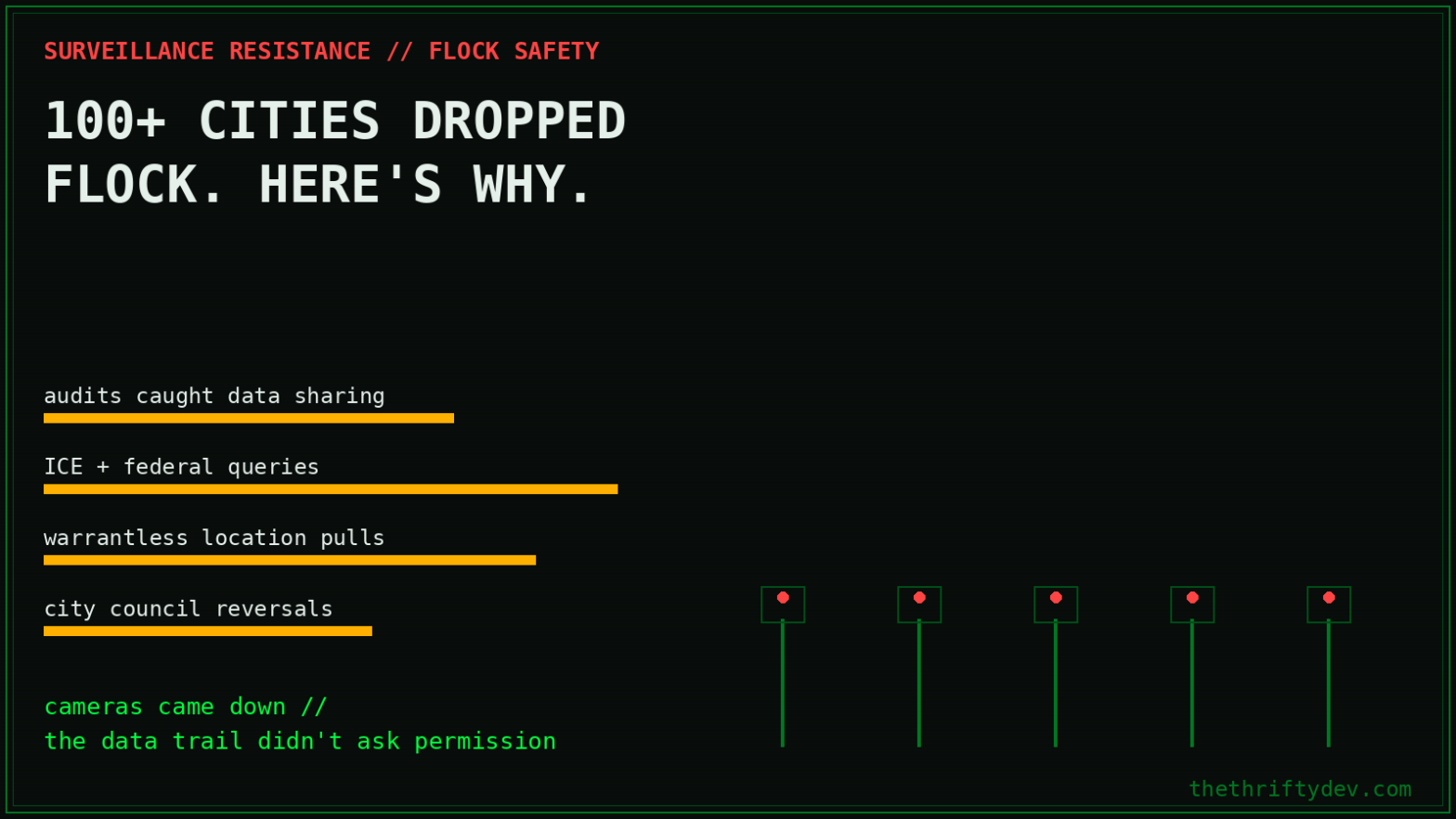
Somewhere between 50 and 227 American local governments have gotten out of the automated license plate reader business since the start of 2025, depending on who is counting and what counts as getting out. The Institute for Justice, a libertarian public interest law firm, says 227. The crowdsourced tracker DeFlock says 153 cities. NBC News, citing the Institute for Justice, says more than 100. Stateline, the statehouse news service, says more than 50 this year alone. All four counts were published within weeks of each other in the late summer of 2026, and all four point the same direction: the fastest-growing surveillance network in the United States is shrinking from the edges inward, one council vote, one sheriff’s order and one state funding cut at a time.
The 48-hour migration playbook: what to move first, what to keep, and the exact apps that won't make you regret it on Monday.
No spam. Practical privacy, AI, backup and tool drops. Unsubscribe anytime.This piece is a companion to our Flock field manual, which remains the authority hub for the technical detail. Here we are counting, naming and dating.
Four tallies, one direction
The Institute for Justice unveiled its database of ALPR contract cancellations on August 26, 2026. “As of Sept. 22, 2026, 227 local governments are included in IJ’s database,” the organization states on its announcement page. The fine print matters: “This list does not include jurisdictions that only paused operations of ALPRs or switched to another provider. This list only includes jurisdictions that canceled ALPR contracts.” IJ counts cancellations and non-renewals since the beginning of 2025, and it argues plainly that the technology itself is the problem: “Rather than narrowly target criminals, ALPRs collect troves of data on ordinary people’s movements and compile them in a database officers can freely access on demand.”
DeFlock, a volunteer project that maps plate readers from verified crowdsourced locations, displayed 143,098 LPRs mapped in the USA and 153 “cities rejecting LPRs” on its front page when read on September 29, 2026. The counters are dynamic and change without notice, and the project’s per-city list could not be independently captured on that date, so the 153 figure should be treated as a live estimate rather than a settled roster.
NBC News reported on August 31, 2026 that “more than 100 local governments have cancelled or not renewed their LPR contracts since the beginning of last year, according to the Institute for Justice.” That is IJ’s number with IJ’s methodology, adopted by a national outlet.
Stateline reported on August 14, 2026 that “more than 50 communities have canceled contracts or deactivated cameras this year,” a narrower window that also includes deactivations rather than only cancellations. The same report notes Flock’s own scale claim: “The company says its technology is used in more than 6,000 communities across 49 states.”
Fortune, citing reporting by the San Francisco Standard, offered a fifth frame on August 24, 2026: “82 Flock contracts terminated across 28 states between August 2021 and May 2026, with 39 of them in just the first five months of this year alone.”
Who disagrees with whom, and why: IJ’s 227 is the largest number because it spans the longest recent window and counts every cancellation and non-renewal, but it excludes pauses and vendor switches by design. DeFlock’s 153 counts “cities rejecting” plate readers, a category that can include rejections of replacement contracts. Stateline’s 50-plus is limited to calendar 2026. The San Francisco Standard’s 82 reaches back to 2021 but counts contract terminations only. The numbers are not contradictory so much as they are measuring different things, and any writer who quotes one without the others is choosing a methodology, not reporting a consensus. For scale, The Intercept reported on September 24, 2026 that Flock told the press over the summer that it operates more than 120,000 cameras nationwide, while a researcher’s map built from Flock’s own archived location data shows more than 170,000 cameras plus more than 130,000 accompanying devices, and that Flock is seeking the map’s removal.
Four ways a camera comes down
The cancellation wave is not one mechanism but four, and the distinction matters because IJ’s headline number only captures the first.
First, the legislative vote. Santa Cruz, California’s council voted 6-1 on January 13, 2026 to end its Flock contract, effective February 12. Councilmember Susie O’Hara said at the meeting, “Flock has made too many mistakes and Flock’s leadership has too often dismissed real, valid concern instead of responding with transparency and accountability,” according to Santa Cruz Local. Harrisonburg, Virginia’s council voted unanimously on July 28, 2026 to end its contract, covered the cameras with trash bags pending removal, and considered an ordinance barring similar mass-surveillance contracts, as The Daily Signal reported. New Hanover County, North Carolina’s commissioners voted 4-0 on September 8, 2026, weeks after 41 residents spoke against the cameras, according to WITN. Pflugerville, Texas’s council unanimously rejected a new Flock agreement in late August 2026 after the discovery, reported by CBS Austin, that nearly 380 agencies had access to the city’s Flock data. Redmond, Washington let its contract expire after a May 26, 2026 council vote, per KUOW. Bastrop, Texas voted September 8, 2026, per Texas Scorecard.
Second, the executive or prosecutorial order. Routt County, Colorado Sheriff Doug Scherar announced on September 2, 2026 that his office is ending its Flock contract, according to the Denver Gazette. In Kosciusko County, Indiana, IJ’s database records that “the county council voted to stop funding Flock cameras and the county prosecutor ordered all agencies in the county to discontinue use.” The Jacksonville Sheriff’s Office said on August 31, 2026 it would discontinue plate reader use throughout Duval County, per NBC News. The LAPD sidelined its Flock relationship in July 2026, according to The Record. Denver Mayor Mike Johnston announced in September 2026 that the city is ending its Flock relationship, per Hoodline.
Third, state-level action. Florida’s Department of Transportation revoked approvals for plate readers in state rights of way on August 31, 2026. FDOT’s Watts cited a “recent exponential increase” in deployments and “concerning reports of misuse, data privacy concerns, and surveillance schemes,” according to NBC News, which notes the order did not affect cameras on private property or local rights of way, which Governor Ron DeSantis said together account for 98 percent of the cameras. In Texas, Governor Greg Abbott ordered all state agencies to pause funding for Flock cameras on August 27, 2026, as Texas Public Radio reported, on the eve of a Texas Tribune investigation into at least $30 million in state grants. The Texas Tribune’s reporting, republished by Salon on September 28, 2026, found at least 900 Flock cameras unplugged in Texas since the funding cut and 14 cities and counties dropping contracts or cutting camera counts.
Fourth, the pause. Lynchburg, Virginia temporarily shut off all 15 of its fixed Flock cameras for an independent review of policies, procedures, training and operational practices; police said the pause was not prompted by identified misuse, per The Center Square. Summit County, Colorado’s Sheriff’s Office paused its 30 cameras for at least 30 days, per the Denver Gazette’s reporting. These pauses are real but sit outside IJ’s 227, which is exactly why the competing counts diverge.
The misuse record
The cancellations are not happening in a vacuum. The Washington Post published a nationwide review in August 2026, described in written testimony by Alasdair Whitney of the Institute for Justice before the Senate Subcommittee on Crime and Counterterrorism on September 23, 2026: “It identified dozens of officers charged with or accused of using license plate readers for unauthorized purposes. These officers used Flock’s system in 46 of those cases, and in 26 the targets were officers’ current or former partners, their exes’ new partners, or women the officers wanted to meet.”
The named cases are specific. In Milwaukee, detectives investigating officer Josue Ayala “found he secretly used Flock to learn the location of his romantic partner 124 times and that partner’s ex 55 times, according to a February criminal complaint,” CNN reported on July 26, 2026. Ayala agreed to resign and to plead guilty to attempted misconduct in public office. The detective who investigated him, Tehrangi Chapman, was arrested in July 2026 and “admitted to using Flock to track two people and to secretly installing a GPS device on one person’s vehicle, according to a criminal complaint.”
In Indianapolis, five officers of the Indianapolis Metropolitan Police Department, which leases 301 Flock cameras across Marion County, were charged in September 2026. Indiana Public Radio named them: Matthew Dane Binford, Abigail Cramer, Cassandra Crawley, Michael Rogers and Jonathan Schultz, with charges including multiple counts of fraud and official misconduct for alleged “thousands of impermissible searches.” Schultz received 26 counts, including 12 counts of fraud and two counts of stalking. These are charges, not convictions, and the cases are pending.
In Albany County, New York, a longtime sheriff’s investigator was arrested on September 9, 2026 and, per WAMC’s headline, “searched Flock cameras for ex’s car 3,000 times.” In Monroe County, Florida, 404 Media documented deputy Lamar Roman tracking and pulling over a woman he had met while working a security detail on the set of the AppleTV+ show Bad Monkey. In St. Charles County, Missouri, an internal audit found an employee had looked up Flock data for “personal reasons,” and the county terminated the contract and bagged its 28 cameras on August 20, 2026. Police Chief Kurt Frisz said in the county’s press release, “This employee’s egregious misuse of the data system may be limited to a personal matter, but I am committed to ensuring that every use of the tools law enforcement have are audited, from my own access to the newest recruit. And then we ensure we audit the auditors.”
IJ’s Database of ALPR Abuse, cited in Whitney’s testimony, “now catalogs more than 240 incidents nationwide,” including a Texas sheriff’s deputy who “used 83,000 Flock ALPRs to find a woman who had allegedly had a medication abortion, at the behest of her abusive partner,” and a Georgia police chief who “tracked his ex-girlfriend and her teenage daughter roughly 600 times.” Separately, EFF reported on September 14, 2026 that officers fill Flock’s search-reason fields with joke text, under the headline “The High Crime of ‘LMAO’: How Cops Are Treating Flock’s Mass Surveillance As a Joke.”
Access control failures compound the misuse record. Boston’s 2025 Surveillance Technology Report, covered by WBUR on September 14, 2026, found Flock distributed data to external agencies three days into the city’s pilot despite contractual promises: “The contract clearly noted that data sharing was to be disabled, and BPD confirmed with Flock that settings were ‘off’ for sharing,” the report states. A community-produced audit of Woodland, California’s Flock records, published by advocates in March 2026 and not independently verified, reports 4,353 immigration-enforcement searches and 2,632,310 out-of-state searches flagged as potential violations of California’s SB 34 by 4,259 organizations between 2021 and 2026.
The vendor swap
Dropping Flock, for many jurisdictions, has meant buying someone else’s plate reader. The swaps converge on Axon, the public safety company whose fixed license plate reader camera is sold under the Outpost name, per Axon’s published product materials. Denver is moving its ALPR contract to Axon, Mayor Mike Johnston announced in September 2026, after months of council disputes over privacy and federal data access, per Hoodline. Tempe, Arizona, which held an $80,000 Flock contract according to The Hill, voted unanimously in March 2026 for an Axon pilot, per the Phoenix Independent: “The Tempe City Council recently unanimously passed a motion to start a pilot program with Axon.” The LAPD’s Axon turn came alongside a $235 million body camera contract, per the Los Angeles Times on July 14, 2026. Boston’s police department launched pilots with roughly 45 Motorola cameras in February 2026 and about 30 Axon cameras on June 1, 2026, disclosed only in the annual surveillance report, per Government Technology. Richmond, California was set to consider an Axon switch on September 15, 2026, per Richmondside, and Fort Collins, Longmont, Durango, Port Hueneme, Syracuse and Asheville, the last under a 7.5-year agreement, all reportedly moved to Axon in 2026, per local outlets.
The counterexample is Albany, California, which on September 8, 2026 rejected a proposed Motorola contract covering up to 24 locations days before its Flock contract expired, with Vice Mayor Jennifer Hansen-Romero abstaining, per the Albany Scanner. The ACLU’s Jay Stanley, writing on August 25, 2026, made the structural point: Motorola’s Vigilant unit operates the National Vehicle Location Service, “a nationwide law enforcement data sharing system similar to Flock’s,” and switching vendors, in the ACLU’s framing, does not necessarily fix mass surveillance.
The courts
Here is the plain statement: as of September 29, 2026, no court has held that warrantless historical queries of ALPR databases violate the Fourth Amendment. The one federal case to reach a decision went the other way. In Schmidt v. City of Norfolk, No. 2:24-cv-621 (E.D. Va.), U.S. District Judge Mark S. Davis dismissed the challenge on January 27, 2026 in a 51-page opinion, writing that “plaintiffs are unable to demonstrate that defendants’ ALPR system is capable of tracking the whole of a person’s movements.” Norfolk residents Lee Schmidt and Crystal Arrington, represented by IJ, had been captured 475 and 325 times respectively over four months. Flock’s chief legal officer Dan Haley said the ruling “recognizes the difference between fixed LPR, which records an image of a vehicle at a single moment in time, and continuous tracking technologies like mobile phones or GPS trackers.” The appeal is pending as No. 26-1227 in the Fourth Circuit, where EPIC, the New Civil Liberties Alliance and the ACLU filed amicus briefs on April 20, 2026. Judge Davis himself wrote a caveat the Norfolk Virginian-Pilot editorial page highlighted: “Because rapid technological advances, such as the rise of artificial intelligence, make it impossible to predict how police surveillance will evolve, the Fourth Amendment analysis must remain nimble even as it remains grounded in founding-era traditions.”
Three other matters define the field. EFF and the ACLU of Northern California sued the City of San Jose, its police chief and its mayor in California state court in November 2025 on behalf of SIREN and CAIR California, challenging warrantless searches of a database fed by nearly 500 cameras and a year of retention. Separately, IJ’s Senate testimony cites Tan v. City of San Jose, No. 5:26-cv-03181 (N.D. Cal., filed April 15, 2026). And in United States v. Chatrie, No. 23-6075 (4th Cir.), the same circuit that will hear Schmidt’s appeal considered a warrantless geofence demand for Google location data; the district court declined to suppress, a panel majority resolved the case on good-faith grounds without deciding the Fourth Amendment question, and the court granted rehearing en banc. Readers should check the docket for the current posture, but the case’s trajectory is the reason both sides treat the Fourth Circuit as the front line.
Why is the doctrine moving toward the drivers even without a holding? Because the Supreme Court held in Carpenter v. United States (2018) that seven days of historical cell-site location data requires a warrant, and every court in this field now writes in Carpenter’s shadow. Because Judge Davis’s own opinion concedes the analysis must adapt. Because legislatures are acting as if the constitutional question is live: Washington’s Driver Privacy Act, SB 6002, signed by Governor Bob Ferguson on March 30, 2026, requires warrants for ALPR data from private entities; Connecticut SB 397 caps retention at 21 days; New Mexico SB 40 and Illinois’ 625 ILCS 5/2-130 restrict sharing for immigration and reproductive health care investigations; and Missouri Governor Mike Kehoe wrote in Executive Order 26-18 that “the government should not be building a permanent record of where law-abiding Missourians go, who they visit, or how they live their daily lives.”
Same architecture, new logo
The closing observation belongs to the ACLU, which warns that switching providers does not necessarily change what the system is. The cameras that replaced Flock’s in Boston and Denver are fixed plate readers on the same poles, feeding databases with the same retention periods, the same broad partner-access networks and the same audit gaps that surfaced in Pflugerville and Boston. A vendor swap changes the logo on the camera. It does not change the architecture, and the architecture is what the 227 cancellations, the 240-plus abuse incidents and the pending appeals are all, in their different ways, about.
Sources
- Institute for Justice, ALPR cancellation database announcement: ij.org/institute-for-justice-unveils-new-database-tracking-cancelations-of-license-plate-reader-contracts/
- IJ Database of ALPR Abuse: ij.org/the-ij-database-of-alpr-abuse/
- DeFlock front page counters, read 2026-09-29: deflock.org/
- Stateline, 2026-08-14: stateline.org/2026/08/14/flock-safety-tightens-safeguards-as-states-cities-question-surveillance-network/
- NBC News, 2026-08-31: www.nbcnews.com/tech/tech-news/florida-bans-flock-license-plate-readers-state-highways-rcna595420
- Fortune, 2026-08-24: fortune.com/2026/08/24/flock-8-billion-startup-backed-a16z-tiger-surveillance-camera/
- Santa Cruz Local, 2026-01-13: santacruzlocal.org/2026/01/13/santa-cruz-leaders-vote-to-terminate-contract-with-flock/
- The Daily Signal, 2026-07-30 (Harrisonburg, Charlottesville): www.dailysignal.com/2026/07/30/get-the-flock-out/
- WITN/WECT, 2026-09-08 (New Hanover County): witn.com/2026/09/08/new-hanover-county-pulls-plug-flock-camera-contract
- Statesman and CBS Austin, 2026-08 (Pflugerville): www.statesman.com/news/local/pflugerville/article/pflugerville-flock-license-plate-readers-22404293.php cbsaustin.com/news/local/pflugerville-shuts-down-flock-system-after-finding-hundreds-of-unapproved-users
- KUOW, 2026-05-26 (Redmond): www.kuow.org/stories/redmond-will-let-its-flock-camera-contract-expire
- Texas Scorecard, 2026-09-08 (Bastrop): texasscorecard.com/local/bastrop-city-council-votes-to-end-flock-camera-contract/
- St. Charles County press release, 2026-08-20: sccmo.org/m/newsflash/Home/Detail/2772
- The Center Square (Lynchburg): thecentersquare.com/virginia/article_7a990eab-ac43-4899-9210-5e6c8c36569a.html
- Denver Gazette, 2026-09-25 (Routt County, Fort Collins, Steamboat Springs, Moffat County): denvergazette.com/2026/09/25/ditch-or-switch-colorado-governments-decide-fate
Frequently asked questions
How many cities have dropped Flock Safety?
It depends on the counting rule, which is why this article reports every published tally instead of one. The Institute for Justice database listed 227 local governments as of September 22, 2026, DeFlock displayed 153 cities rejecting plate readers on September 29, 2026, NBC News reported more than 100 cancellations and non-renewals, and Stateline reported more than 50 in 2026 alone.
What are cities replacing Flock cameras with?
Often another vendor’s plate reader, most visibly the Axon Outpost. Denver, Tempe, Los Angeles, Boston, Richmond, Fort Collins, Longmont, Durango, Port Hueneme, Syracuse and Asheville all moved to or piloted Axon systems in 2026. The ACLU’s point is that the cameras stay on the same poles and feed databases with the same retention periods.
Has any court ruled that warrantless license plate reader searches are unconstitutional?
No. In Schmidt v. City of Norfolk, No. 2:24-cv-621 (E.D. Va.), the court dismissed the challenge on January 27, 2026, and the appeal is pending in the Fourth Circuit as No. 26-1227. The Fourth Amendment question is still open, which is why both sides treat the Fourth Circuit as the front line.
Read next
What Frontier AI Actually Costs, and What Each Provider Keeps: The September 2026 Price and Privacy Table
15 min read·Published Sep 29, 2026NostrXFacebookRedditTelegramSMSCopyOn this page▾The price table: hosted inference, per million tokensThe retention table: what each provider’s own documents…
Open Weights Licensing in 2026: What You Can Actually Ship
0 0 votes Article Rating Part of Start Here This article is not legal advice. It is a survey of published license…
The Local Model VRAM Tracker
0 0 votes Article Rating Part of Start Here Data in this page is as of 29 September 2026. Prices move fast,…